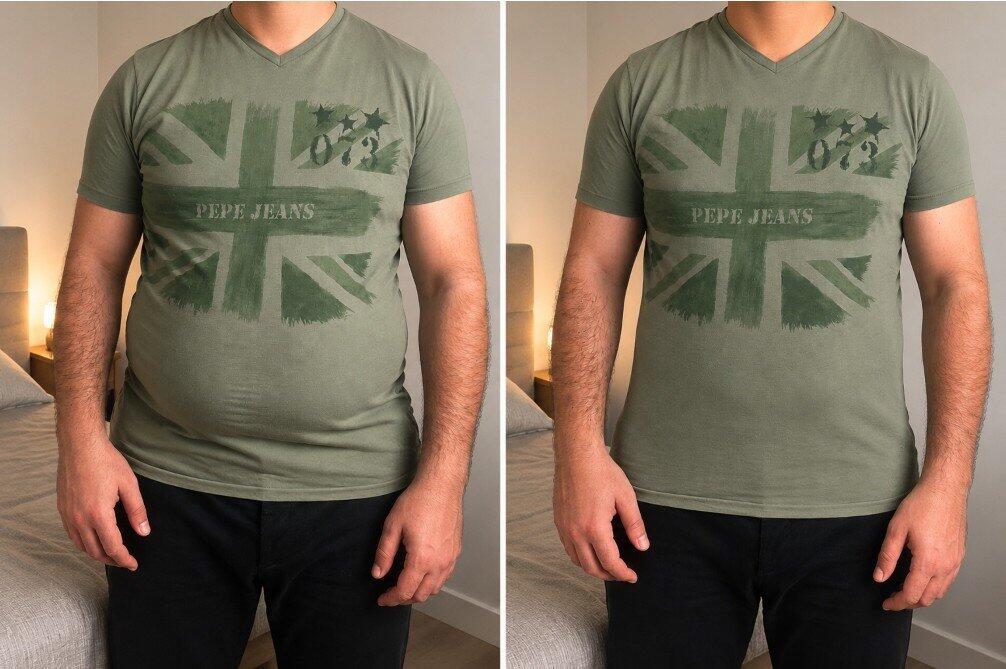
Belly Hanging Out of Your Shirt? Why It Happens and How Bigger Men Can Fix the Fit
Your T-shirt looks long enough while you stand still. Then you sit, reach overhead, or move through the room, and the lowest part of your belly appears below the hem. You pull the shirt down, it climbs again, and the rest of the day becomes a small negotiation with the same piece of fabric.
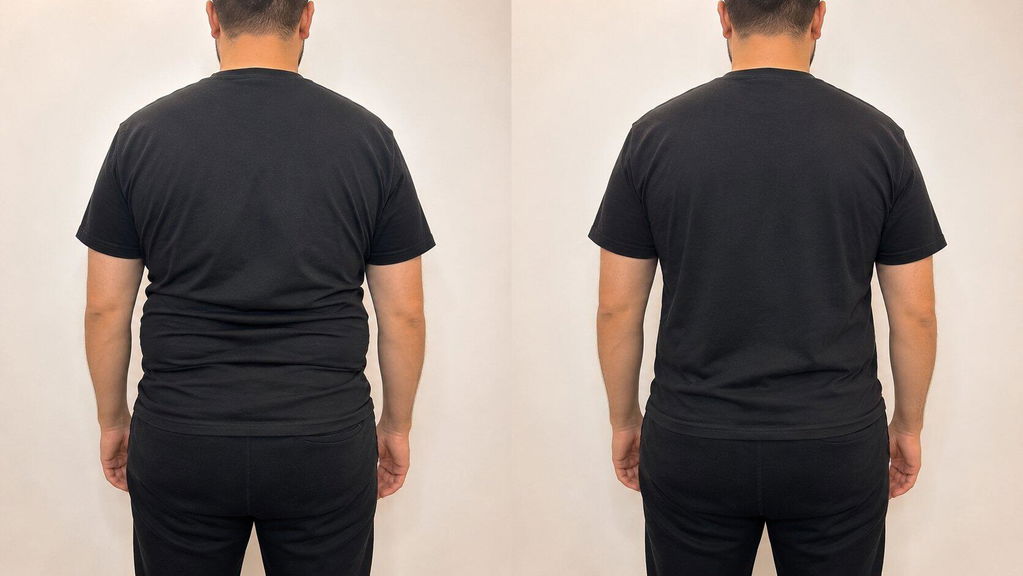
This is not always a “buy a bigger shirt” problem. Men describe shirts that gain width without gaining useful front coverage, tall sizes that change other proportions, and underlayers that introduce their own heat or visibility tradeoffs.
When your belly hangs out below your shirt, first identify when the coverage fails. If it happens while standing, check front length and cut. If it happens only when you sit or raise your arms, test movement coverage. If a larger size becomes baggy everywhere else, the problem is proportion rather than size alone. Add an underlayer only after the outer shirt passes those checks.
Why Your Belly Appears Below the Shirt
A shirt can fit the shoulders and chest while still failing to cover the lowest part of a fuller stomach. The useful question is not only “Does this size fit?” but “Does this shirt keep enough front coverage in the positions where I actually wear it?”
Men describe four different failures that can look identical in a mirror: the hem is already too high while standing, the shirt loses coverage during movement, the garment has enough width but poor proportions, or the shirt and underlayer keep shifting during the day.
Why raising your arms pulls the hem upward
The body of a shirt is connected to the shoulder and armhole area. When your arms rise, fabric has to travel over the shoulders and upper torso. If the shirt has little spare length or movement room, that fabric is borrowed from below, so the hem climbs even though the shirt looked long enough while you were standing.
Garment researchers describe this as a dynamic-ease problem: the movement allowance needed for arm raising changes with arm height, underarm sleeve length, and side-seam length. The research does not prescribe one universal T-shirt measurement, but it supports the practical point that a shirt must be judged in motion, not only in a standing pose. Read the arm-raising garment study.
Why sitting changes the fit
Sitting changes the angle between your torso and thighs, pushes the stomach forward, and brings the front of the shirt against the waistband. That uses up slack in the body of the garment. A shirt that only just covers the belly while standing can therefore lift at the hem, tighten across the stomach, or separate at the lower buttons once you sit.
Research on personalized clothing also treats sitting as a separate design posture because body dimensions and garment tension can change from standing. One open-access study focused on lower-body garments and female participants, so it is not proof of a male T-shirt outcome; it is useful here for the narrower principle that standing fit does not fully predict seated fit. See the sitting-posture clothing study.
| Failure type | What you notice | First thing to inspect |
|---|---|---|
| Resting coverage failure | The belly is visible below the hem while you stand naturally. | Actual front coverage and cut, not only the size label. |
| Movement coverage failure | The shirt covers at rest but lifts when you sit, bend, walk, or raise your arms. | The same shirt in motion before deciding to size up. |
| Proportion failure | The stomach needs room, but a larger size becomes wide, long-sleeved, or tent-like elsewhere. | Regular versus tall proportions, cut, and possible alteration. |
| Layer stability failure | You keep pulling the shirt or undershirt down, retucking it, or checking whether it has moved. | How the layers behave together during a normal day. |
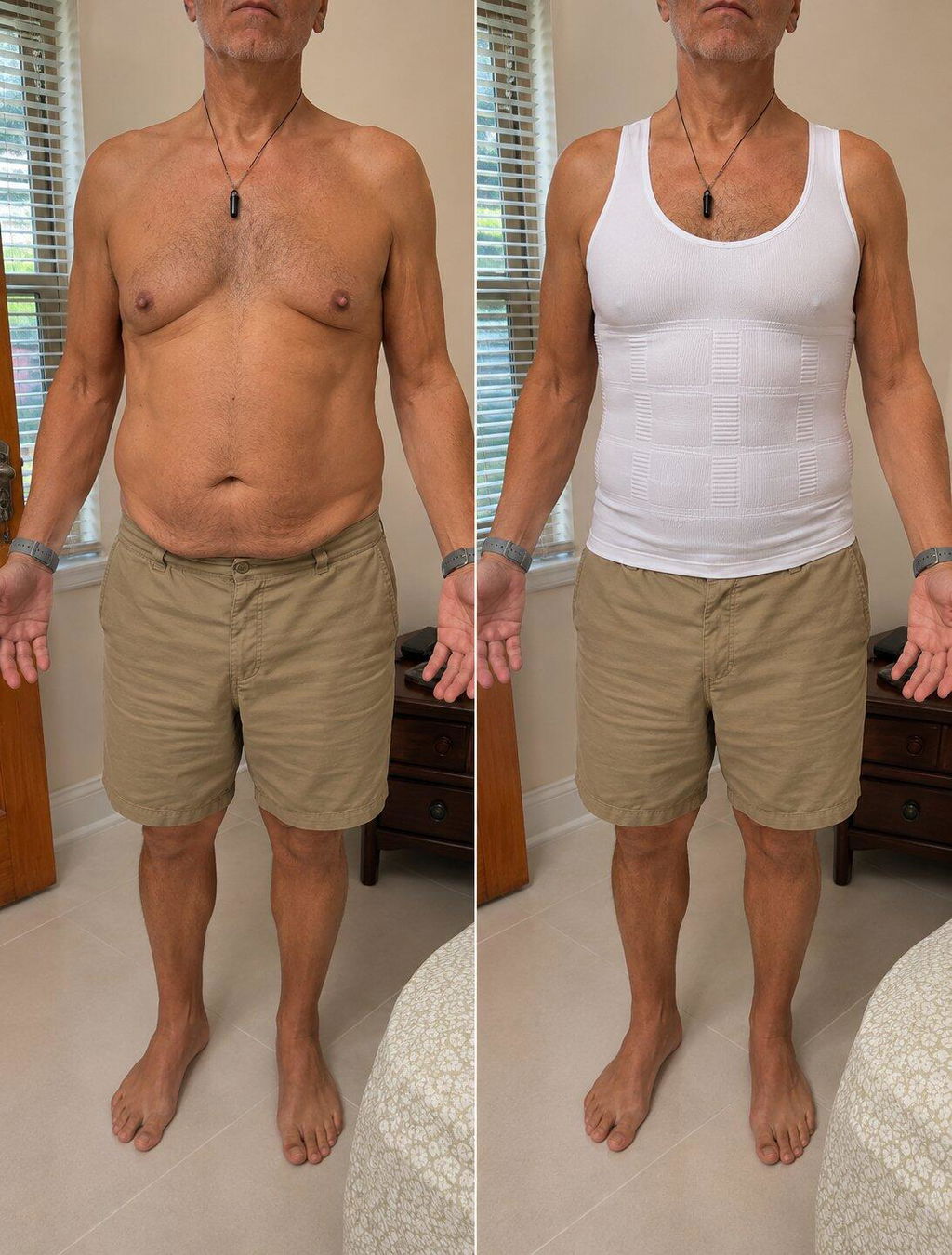
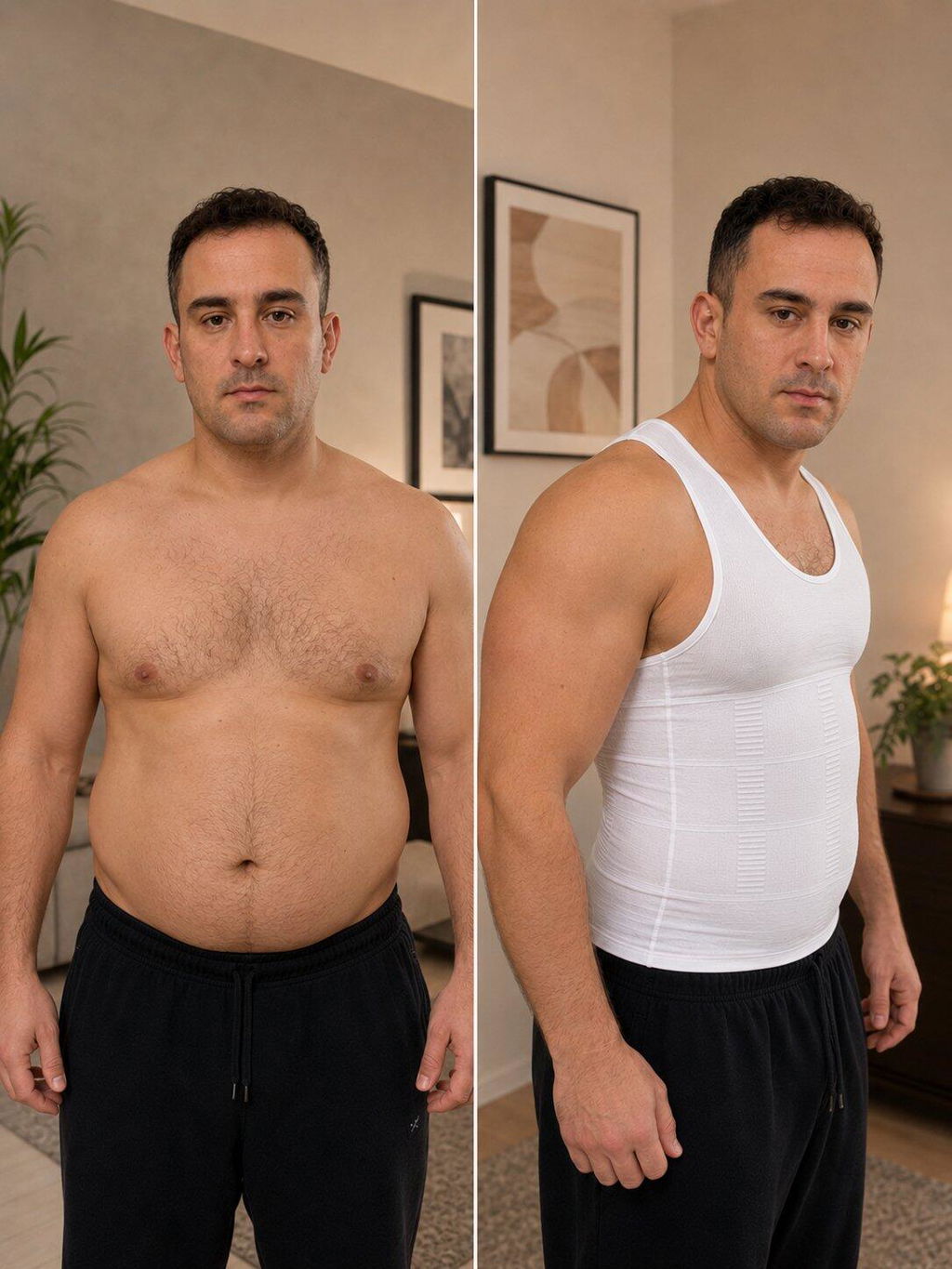
If the outer shirt already has enough front coverage and your next question is about a continuous layer underneath, compare what a smoothing undershirt for men is meant to help you evaluate before changing the outer size again.

Use the Four-Position Shirt Coverage Test
You leave the mirror thinking the shirt works. Then you sit at your desk, reach for something above you, or walk across the room and feel the hem move. Your hand goes straight back to the bottom of the shirt before you have even decided to adjust it.
Men repeatedly describe the problem appearing in sitting, reaching, exercise, public movement, and the moment they realize they are pulling the shirt down again. Judge the shirt in those positions, not from one still pose.
Why the movement test matters: research on personalized men’s jackets has used dynamic measurements from male subjects to design for movement rather than relying only on static body dimensions. That study concerns jackets, not this specific T-shirt problem, but it reinforces the same testing principle: fit should be checked in the positions the garment must handle. Review the dynamic menswear study.
1. Stand naturally
Let your stomach rest normally and leave the shirt alone. If the lowest part of the belly is already visible, the first issue is basic front coverage rather than movement.
2. Sit the way you sit at work or in a restaurant
Guys describe shirts that look acceptable standing and expose the stomach or separate around the lower buttons only after they sit back. Test that change before accepting the shirt as a good fit.
3. Raise both arms
Gym and movement-related threads document shirts exposing the stomach during overhead movement even when the wearer likes the shirt at rest. If this is the only failing position, treat it as movement coverage rather than proof that every part of the shirt is too small.
4. Walk, bend, and stop adjusting
Walk for a minute, bend once, sit once, and notice whether your hand immediately reaches for the hem. Repeated shirt pulling is useful evidence that the garment system is not staying where you expect it to stay.
Do not use a fake universal measurement. Men describe different torso lengths, belly shapes, trouser positions, and shirt proportions, so a movement test is more useful than one invented “ideal” number of inches.

Fix the Outer Shirt Before Adding Another Layer
An underlayer cannot make a genuinely short outer shirt longer. If the belly is exposed while you stand naturally, start with the outer garment.
Check usable front coverage, not only labeled size
The community evidence shows why “just size up” is incomplete advice. Some men gain enough room at the stomach but dislike the extra width, dropped shape, or tent-like result everywhere else.
Compare the actual shirt on your body rather than assuming that XL, XXL, or a tall label automatically solves the same problem across brands and cuts.
Separate width from length
If the shirt is comfortable around the stomach but the hem ends too high, more width may not be the correction you need. If it is long enough but pulls tightly across the belly, adding length alone may not solve the tension.
Use tall sizing as a test, not a guarantee
Men with long torsos often turn to tall sizes, while others describe sleeves or overall proportions becoming excessive when the body length finally works. Tall sizing is therefore a comparison to test, not a universal answer.
Improve the rest of the outfit after coverage works
Once the hem stays where you need it, the next step is coordinating color, layering, and overall proportion. The broader guide to dressing around a fuller stomach helps you build the rest of the outfit around the fit you have just corrected.
If the shirt stays down but still looks bulky or shapeless, the guide on how to make a shirt look slimmer through cut and drape helps you compare silhouette choices without simply buying more fabric.

When the outer shirt passes the test but the layer underneath still matters: the next decision is whether you need a different category of base layer for everyday shirts, not another oversized outer shirt.
Compare the Base-Layer Category
This destination helps you evaluate a compression tank after checking outer-shirt length and fit. It cannot make a short shirt longer or replace correct sizing.
Compare a compression tank built for everyday shirtsWhy the Most Common Fixes Can Fail
You move up one size and the belly is covered, but now the shoulders hang and the body looks like a tent. You tuck the shirt, sit down, and it works loose again. You pull the hem lower, take three steps, and your hand is back at the same spot.
The most useful community experience is not a list of products. It is what men already tried and the tradeoff each attempt created.
“I will buy one size bigger”
This can add stomach room, but men repeatedly describe looking oversized, boxy, or tent-like after moving up a size. It is the wrong correction when the missing feature is front length rather than total width.
“I will keep pulling the shirt down”
Pulling the hem down solves the next few seconds, not the fit. The repeated adjustment itself is evidence that the shirt is moving out of the position you want.
“I will wear my trousers higher”
Some men use a higher trouser position to reduce exposed skin, while others describe pressure, sweat, difficulty finding the right size, or discomfort around the lower belly. The option has to pass the seated test on the individual wearer.
“I will tuck everything in”
Tucking can improve coverage in one outfit, but community experiences also describe shirts becoming untucked or the solution feeling awkward during movement. A tuck is a system that depends on the shirt, trousers, and body position working together.
“I will add a normal undershirt”
A regular undershirt gives some men a continuous coverage layer, but others object to the added heat or to the underlayer looking wrong beneath a nicer shirt. That makes it a conditional option rather than an automatic fix.

T-Shirts, Button-Downs, Work, and Movement Do Not Fail the Same Way
T-shirts usually expose the problem at the hem
The shirt looks fine before the set starts. Then your hands go overhead, the hem rises above the belly, and the camera catches a view that was never visible while you stood still. Men describe the same movement-specific failure during overhead work and floor exercises.
The lesson is not that gym exposure is unacceptable. The useful clothing lesson is that movement can reveal a coverage failure that a standing mirror check misses.
Button-downs can create a separate seated problem
For some larger wearers, the problem appears between the lower buttons only after sitting, while a much larger shirt looks poor and an undershirt feels too hot. This is an adjacent case, not a pattern strong enough to control the whole article.
The dedicated guide on how a dress shirt should fit around a fuller stomach shows how to read lower-button tension, body room, and seated fit when the problem is a button-down rather than a T-shirt hem.
The setting changes the decision
Men describe different tolerance levels at home, during errands, at the gym, at work, in restaurants, and when a camera is present. The same amount of exposure can feel irrelevant in one setting and distracting in another.
Your standard can therefore be practical rather than moral: choose enough coverage for the place where you need the outfit to work, without treating the body itself as the mistake.

When an Underlayer Is Worth Evaluating
You add another layer hoping to stop the exposure. Then the room gets warm, the neckline becomes visible, or you find yourself adjusting two garments instead of one. A base layer only makes sense when it solves the failure you actually have.
An underlayer becomes a logical category to evaluate after the outer shirt has enough basic coverage and the remaining problem is how the layers sit or stay together while worn.
A clothing layer can change how an outer garment sits or drapes while it is being worn. It does not diagnose, treat, or change the underlying body, and it does not replace correct outer-shirt fit.
| Your failure type | First correction | Role of a base layer |
|---|---|---|
| Resting coverage failure | Correct the outer shirt’s front length or cut. | Not the first answer; it cannot extend the outer hem. |
| Movement coverage failure | Test a different body length, cut, or tall proportion in motion. | Possible support only after the outer shirt covers the belly through movement. |
| Proportion failure | Change the cut or alter excess fabric instead of adding width everywhere. | Not a substitute for proportion or tailoring. |
| Layer stability failure | Evaluate how the outer shirt and hidden layer work together during the day. | This is the failure where a dedicated base-layer category becomes the logical option to compare. |
An underlayer may fit the decision when:
- The outer shirt covers the lower belly in the four test positions, but you still want a continuous layer underneath.
- The outer shirt is correctly sized, but the complete outfit still feels unstable or requires repeated adjustment.
- You have compared the heat and visibility tradeoffs for the setting where you will wear it.
An underlayer is not the first correction when:
- The outer shirt exposes the belly while you stand naturally.
- The shirt is pulling so hard around the stomach that the basic size or cut is wrong.
- You expect the layer to lengthen the outer hem or change the body underneath it.
If the hem now stays down but you still want help with fabric choice, side visibility, or the overall outline, the broader guide to hiding belly fat under clothes adds those next decisions.

Review the Base Layer for a Layer-Stability Failure
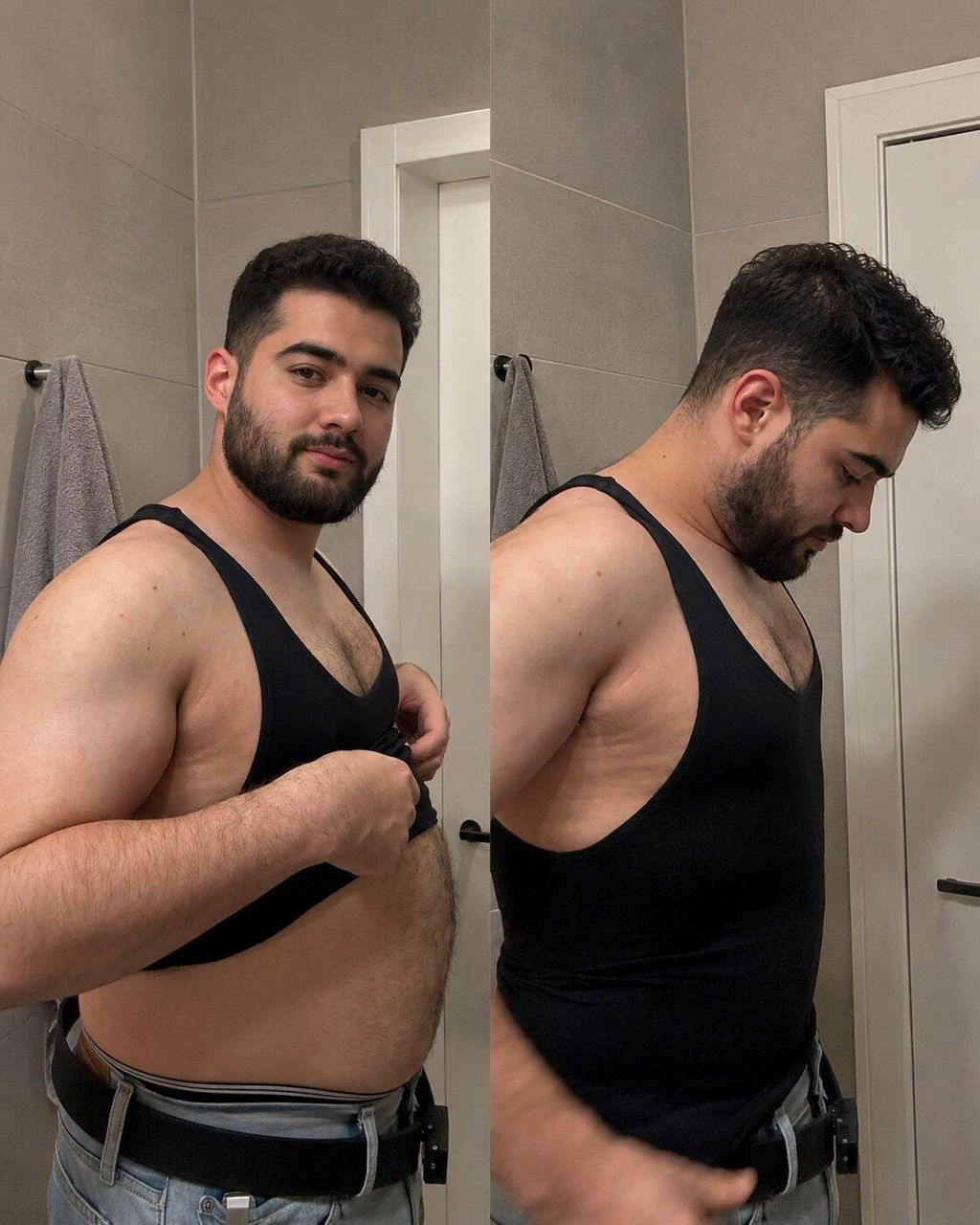
If the outer shirt passes the standing, seated, arms-raised, and walking checks but the outfit still needs repeated adjustment or a more continuous hidden layer, review the VEROSHAPE Compression Tank as a men’s compression base layer worn under clothing. It is not a substitute for an outer shirt that is too short.
Review the VEROSHAPE Compression TankChoose the First Correction From What Actually Fails
| What happens | What it most likely tells you | First correction to test |
|---|---|---|
| Belly visible while standing | Basic front coverage is insufficient. | Different outer-shirt length or cut. |
| Covered standing, exposed with arms raised | The failure is movement-specific. | Compare the shirt in motion, then test a different proportion or length. |
| Larger size covers but looks tent-like | Width increased more than useful proportion. | Compare another cut, tall option, or alteration rather than continuing to size up. |
| Button-down opens around the belly when seated | Seated circumference or cut is failing. | Recheck shirt fit and use the dedicated dress-shirt guide. |
| Higher trousers cover skin but feel hot or tight | The workaround creates a comfort tradeoff. | Try a different rise or return to outer-shirt coverage. |
| Outer shirt passes, but the layers still shift or require repeated adjustment | This is a layer-stability failure rather than an outer-length failure. | Compare a dedicated base-layer category for heat, visibility, and fit without assuming a guaranteed result. |

The practical conclusion: Do not keep buying more fabric until you know what is missing. A bigger shirt solves width. A tall shirt changes length and proportion. A different cut changes where the room sits. An underlayer changes the layer system. Those are four different decisions.
FAQ — Belly Hanging Out of a Shirt
Why does my shirt cover my belly standing but not when I sit?
Sitting changes the position of the stomach, waistband, and shirt at the same time. If the shirt fails only when seated, test seated circumference, front coverage, and whether the hem or lower buttons stay where you expect before changing the whole size.
Should a bigger man size up or buy a tall shirt?
Size up when you need more room around the body; test a tall size when the main shortage is body length. Men describe either choice creating poor proportions elsewhere, so compare both while standing, sitting, and raising your arms.
How can I tell whether a T-shirt is long enough for my belly?
Check it while standing naturally, seated, with both arms raised, and after walking or bending. A shirt is not practically long enough for your use if the belly appears in the positions you need the outfit to handle.
Can an undershirt stop my belly from showing below my shirt?
An undershirt can provide a continuous layer beneath the outer shirt, but it cannot lengthen an outer hem that is already too short. It also introduces heat, visibility, and stability tradeoffs that should be tested in the real outfit.
Why does my button-down gap around my stomach when I sit?
A shirt can look acceptable standing and separate between the lower buttons only when you sit. Treat that as a seated shirt-fit problem involving circumference and cut, not as proof that every part of the shirt needs to be larger.
Can a compression tank fix a shirt that is too short?
No. A compression tank cannot add length to the outer shirt. It is a base-layer category to evaluate only after the outer garment has enough coverage and the remaining decision concerns how the layers sit while worn.
Research and editorial sources
- Ng, Cheung & Yu — Dynamic Ease Allowance in Arm Raising of Functional Garment. Used only to support the general relationship between arm movement and required garment ease.
- Rudolf, Stjepanovič & Cupar — Personalized Clothes for a Sitting Posture. Used only to support treating seated fit as distinct from standing fit; the study’s participants were female and its garment analysis focused on the lower body.
- Avadanei et al. — Dynamic Anthropometry for a Personalized Men’s Jacket. Used only to support testing menswear with dynamic measurements and movement positions.
This article also combines documented search data, verified VEROSHAPE site information, and paraphrased community experiences. Reddit experiences are synthesized rather than presented as VEROSHAPE customer evidence.