How Should Men With Broad Shoulders Dress?
The frustrating part of broad shoulders is not always the shoulders themselves. It is what happens after you finally find a shirt that gives them enough room: the waist can turn baggy, the body can run too long, the sleeves can hang past your wrists, or the upper arms can still feel tight.
Quick answer: men with broad shoulders should fit the upper body first, but not stop there. Check the garment’s intended shoulder line, then move your arms and look for pulling across the chest, upper back, biceps or armholes. Once the upper body works, identify the second failure — usually excess waist fabric, body length, sleeve length or another tight area. Fix that problem with the right cut, garment block or alteration instead of changing size again. After fit works, decide whether you want to emphasize, keep neutral or visually balance your shoulders.

What Counts as Broad Shoulders on a Man?
Broad shoulders are a proportion: your shoulder line reads relatively wide compared with the rest of your frame. There is no single shoulder measurement that makes every man broad-shouldered because chest, waist, torso length and overall build change how the same shoulder width looks.
Clothing can reveal that proportion, but clothing does not define it. A badly cut shirt can pull on someone who does not have especially broad shoulders. The more useful clue is a repeated pattern across different tops: sizes that look right through the body often feel restricted across the shoulders, upper chest, back or arms, while the size that gives you enough room up top becomes loose or long somewhere else.
Broad shoulders are one proportion, not a complete body type.
You can have broad shoulders with a narrow waist, a fuller middle, large upper arms, a short torso, a long torso or almost any other combination. That is why copying one “inverted triangle” outfit formula often fails. The shoulder line tells us where to start the fit check. It does not tell us the whole answer.
Why Standard Sizes Fail Broad Shoulders
Ready-to-wear sizes change several measurements at once. Going from Medium to Large does not only add shoulder or chest room. Depending on the brand and garment, it can also add waist width, body length, sleeve length and room through the arm.
That creates the classic broad-shoulder compromise: the smaller size looks cleaner below the chest but restricts the upper body; the larger size gives the shoulders room but leaves too much fabric at the waist or too much length below.
The useful question is not “Which size am I?” Ask: Which part is hardest to fit, and what breaks after I fit it?
This is also why labels such as athletic, tailored, muscle, slim and regular should be treated as starting clues rather than standards. One brand’s athletic fit can have a strong chest-to-waist taper; another may simply be a slightly narrower regular fit.
Shop the block, not the label. Look at the measurements and the pattern underneath the marketing name: shoulder and chest room, biceps, armhole shape, torso taper, body length and sleeve length. When garment measurements are available online, compare them with a shirt that already fits you well instead of relying only on S, M or L.

The Broad-Shoulder Fit Check
A shoulder seam can be useful, but it is not a verdict. Different garments intentionally place that line differently. A traditional set-in shirt, a dropped-shoulder tee and a raglan top are not supposed to look the same.
For a conventional shirt, the shoulder/yoke area is still worth checking. But even a line that looks visually reasonable can hide tension elsewhere. Shoulder width and shoulder slope are also different fit variables: a shirt can have enough width and still create diagonal pulling if the shape does not agree with your shoulder angle.
Use this order:
1. Shoulder construction: does the intended shoulder line sit and drape as designed?
2. Movement: can you reach forward, cross your arms and raise them without hard pulling across the chest, upper back, biceps or armholes?
3. Torso: once the upper body works, does the body hang cleanly or balloon at the waist?
4. Length: check body length and sleeve length separately.
5. Visual goal: do you want to emphasize, keep neutral or visually balance your shoulder width?

The most important step is what happens between steps two and three. Once the upper body finally works, stop changing size for a moment. Look for the second failure. A new size changes several dimensions again; a different cut or alteration may solve the second problem more directly.
Diagnose What Fails Next
Broad-shoulder fit is often a two-problem puzzle. First you solve the upper-body restriction. Then another issue becomes obvious. Treat that second issue as its own problem.
Shoulders fit, but the waist balloons
This is common when your shoulder or chest measurement needs a larger upper block than your waist does. Sizing down may remove the excess fabric, but it can put you straight back into tight shoulders or arms.
Better first moves are a shirt with more torso taper, an athletic or tailored block that actually matches your measurements, or a torso alteration when the garment and cost make sense. If you are broad through the shoulders and broad through the rest of the frame, this becomes a different full-body proportion problem; the guide to dressing a stocky build goes deeper on that situation.
Shoulders fit, but the body is too long
Extra shoulder room and extra body length often arrive together in ready-to-wear sizing, even though your torso does not necessarily need both. A shorter garment block or a hem adjustment can be more direct than sizing down and losing the upper-body room you just found.
Height is not a perfect shortcut. Two men of the same height can have different torso and leg proportions. If shirt and jacket length repeatedly fight your proportions, see the separate guide to long torso and short-leg proportions rather than treating height alone as the diagnosis.
Shoulders fit, but sleeves are too long
Sleeve length is another independent dimension. A larger shirt can fix shoulder width and create sleeves that are longer than you need. Look for brands or lines with separate sleeve-length options, or consider alteration when the garment construction allows it and the piece is worth keeping.
The seam looks right, but movement still fails
This is where strict shoulder-seam rules break down. If reaching forward creates strong pulling across the upper back, or the chest and armholes still feel restrictive, the problem may be elsewhere in the upper block. More shoulder width is not automatically the answer.
Look at where the tension appears. Chest pulling, upper-back restriction, tight biceps and high or restrictive armholes can all make a shirt feel “too small in the shoulders” even when the visible shoulder line seems reasonable.

What can actually be altered?
Alteration is useful when the hardest area already fits and the remaining problem is more local. But “just tailor it” is not a universal answer. A woven shirt, jersey T-shirt, sweater and structured jacket are different jobs, and the cost or feasibility depends on construction.
| After the shoulders fit | Better first move | Why |
|---|---|---|
| Waist is too loose | Different taper/block or possible torso alteration | You keep the upper-body room instead of shrinking the whole garment. |
| Body is too long | Shorter-length block or hemming where appropriate | Length can be treated separately from shoulder width. |
| Sleeves are too long | Sleeve-length option or alteration depending on garment | Arm length does not have to scale with shoulder width. |
| Biceps or armholes are too tight | Different upper-body block first | Changing the torso alone does not create the missing arm room. |
| Upper back still restricts movement | Different chest/back construction or cut | A visually acceptable seam does not guarantee mobility. |
| Structured jacket shoulder is wrong | Try a different jacket block before relying on reconstruction | Shoulder work on structured tailoring can be more involved than simple waist suppression. |
Choosing T-Shirts, Shirts and Jackets for Broad Shoulders
Once you understand the failure pattern, garment labels become easier to use. You are no longer looking for “the best shirt for broad shoulders.” You are looking for the upper-body room you need without accepting the wrong waist, length or sleeve dimensions.
T-shirts and polos: start with the upper block
A T-shirt that is neat at the waist but stretched across the upper chest or sleeves is not a win. Neither is a tee that finally clears the shoulders but hangs like a straight tube below them.
Look for enough shoulder, chest and upper-arm room first, then judge taper and length. If those T-shirt zones are creating a combined fit problem rather than a shoulder-only one, use our guide to T-shirts for muscular men for the full multi-zone fit check. A slightly shaped body can work well for a broad-shouldered man with a narrower waist; a straighter body may make more sense when the midsection is fuller.
If you wear sleeveless tops, shoulder width is only one part of the decision. Strap width, armhole depth and back shape change how much of the shoulder, chest and sides are exposed; see our guide to tank top cuts and fits for men.
For broader advice on tops across larger frames, see the style guide for bigger men for fit decisions beyond the shoulders.
Is athletic fit good for broad shoulders?
Often worth trying, never guaranteed. Athletic-fit shirts are commonly intended to combine more upper-body room with a narrower torso, which matches one frequent broad-shoulder problem. But the label is not standardized. If the shoulder, biceps, taper or length measurements are wrong for you, “athletic” on the tag does not rescue the fit.
Dress shirts: the collar and shoulder line are only the beginning
Dress shirts add more checkpoints because the collar, yoke, chest, sleeves, cuffs and shirt length all interact. If the problem extends beyond shoulder-first fit into a multi-zone dress-shirt conflict across the collar, chest, arms, waist or lengths, use our guide to athletic fit dress shirts for muscular men. Fit the upper body without accepting hard pulling, then check whether the torso can be shaped without losing movement.
If your main problem is specifically a dress shirt through the chest or middle, see the deeper guide on how a dress shirt should fit through the chest and torso.
Jackets and suits: get the shoulder structure close before chasing the waist
A jacket makes shoulder fit more consequential because the shoulder area can include padding, canvas, sleeve-head structure and other construction that is not the same as taking in a shirt body.
Start with a jacket whose shoulder line and upper chest move cleanly. Then judge the body. A broad-shouldered man with a narrower waist may need more suppression below the chest; another man may need a straighter body. Do not choose a jacket solely because it creates the strongest V-shape while standing still.
Set-in or raglan sleeves?
A set-in sleeve gives you a conventional shoulder seam to inspect. A raglan sleeve runs from the underarm toward the neckline, so there is no standard shoulder-edge seam to judge in the same way.
That does not make raglan automatically better for broad shoulders. It can change where the garment accommodates or visually softens the shoulder line, but the chest, upper arm, underarm and torso still have to fit. Choose it because the pattern works on you, not because the construction name promises a cure.

Emphasize, Keep Neutral or Balance Your Shoulders
Many style guides assume broad shoulders are something to minimize. That is only one possible goal. Some men like the width and want clothing to show it. Others want the shoulder line to feel less dominant. Plenty simply want a clean fit without trying to manipulate proportions in either direction.
| Your goal | What to prioritize | What to watch |
|---|---|---|
| Emphasize | Clean upper-body fit, visible shoulder line, controlled torso taper | Do not make the waist so tight that movement or drape suffers. |
| Neutral | Natural shoulder construction, balanced fit, moderate contrast | Avoid solving a visual problem you do not actually have. |
| Balance | Less visual weight at the shoulder, enough lower-body presence, smoother contrast | Extreme shoulder structure or an extremely narrow lower silhouette can increase the contrast you are trying to reduce. |
Necklines and sleeve construction can change how the upper body reads, but there is no universal neckline that every broad-shouldered man should wear. A neckline is one part of the whole top. Shoulder width, sleeve opening, color contrast and torso taper can have as much or more influence on the final look.
The same applies to pants. You do not need wide trousers simply because your shoulders are broad. If your goal is visual balance, an extremely narrow lower-body silhouette can make the upper body look more dominant; a straight or moderately shaped lower half may create a calmer overall proportion. If you want the strongest V-shape possible, that same contrast may be intentional.
If the proportion works the other way — with relatively more width through the lower torso and hips — the guide to wide hips in men covers that separate balance problem from the trouser top block through the full outfit.

What should broad-shouldered men avoid? There is no universal banned list until you know your visual goal. Two better rules apply almost every time: do not accept restricted upper-body movement, and do not keep changing size to solve different pattern problems.
Different Broad-Shouldered Builds Need Different Fixes
“Broad shoulders” tells us where one proportion is dominant. The rest of your body decides what the second failure is likely to be.
Broad shoulders + narrow waist
Your main problem is often taper. Fit the shoulders, chest and arms first, then look for a body block that removes excess fabric below the chest without squeezing the upper body. Athletic or tailored cuts may be useful starting points, but compare actual measurements.
If the fit problem extends beyond the shoulders — for example, you also need more room through the chest, arms or thighs while the waist remains comparatively narrow — use our clothes for muscular men guide to diagnose the fit across your whole build.
Broad shoulders + large chest or big arms
Shoulder width may not be the only hard measurement. A shirt can clear the shoulders and still bind at the chest, biceps or armholes. Movement matters more here than getting one seam to land at a textbook point.
If the shoulders fit but the remaining problem is localized to the sleeves, biceps or underarm, use our guide to tight sleeves and big-arm fit to diagnose the arm-specific restriction.
Broad shoulders + fuller middle
Do not force a narrow athletic taper just because broad shoulders are associated with a V-shaped torso. You may need upper-body room and enough midsection room at the same time. If the problem becomes a broader full-body fit decision rather than a shoulder-specific one, the stocky-build fit guide is the better next step.
Broad shoulders + short torso or shorter arms
The size that fits the shoulders may add body and sleeve length you do not need. Look for shorter length options, separate sleeve lengths or alterations that preserve the upper-body room.
Broad shoulders + long torso or longer arms
The opposite problem exists too. A top can fit the shoulders but become too short at the hem or cuffs. Do not treat “tall” and “broad” as interchangeable. Torso and arm length need their own check.
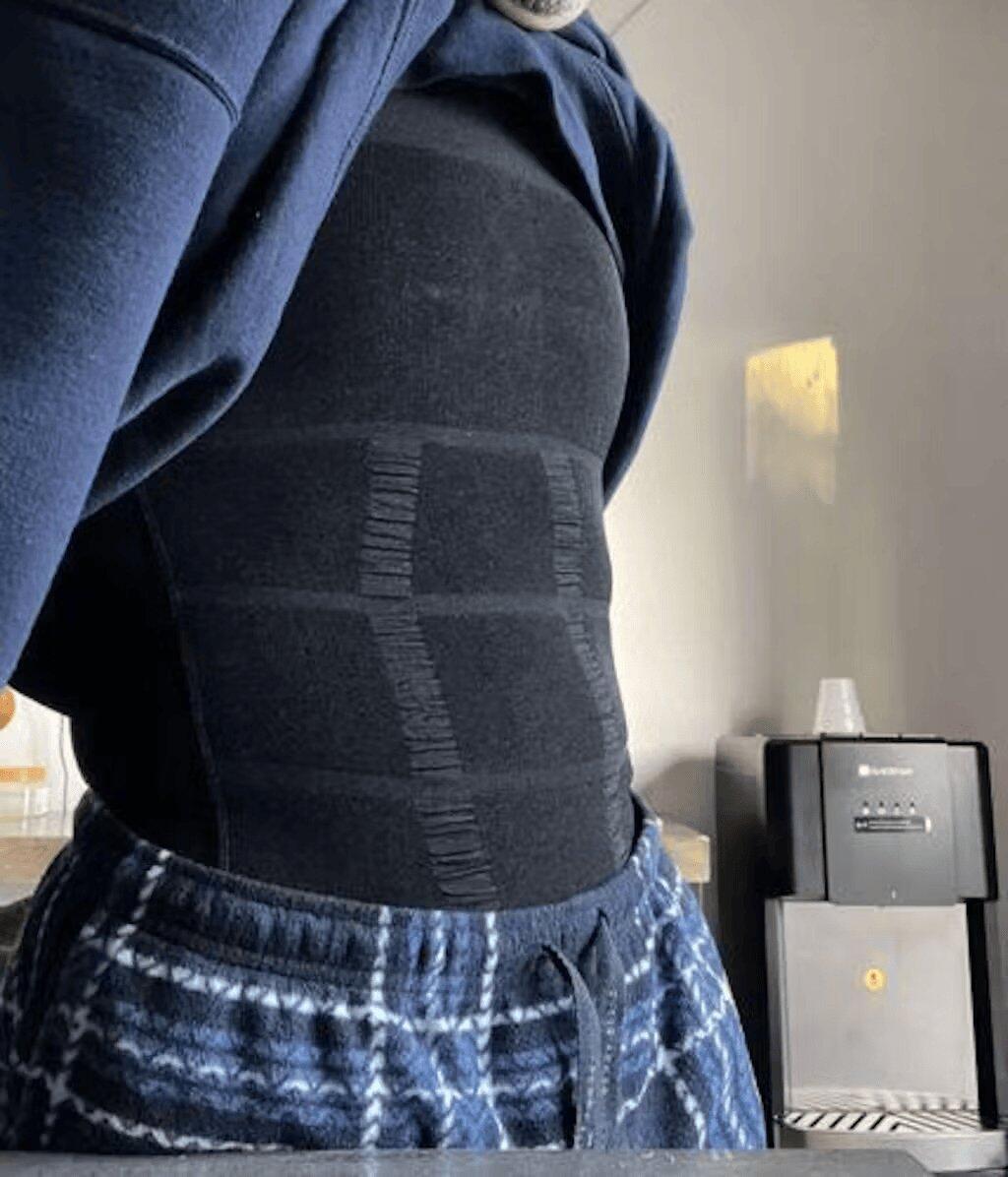
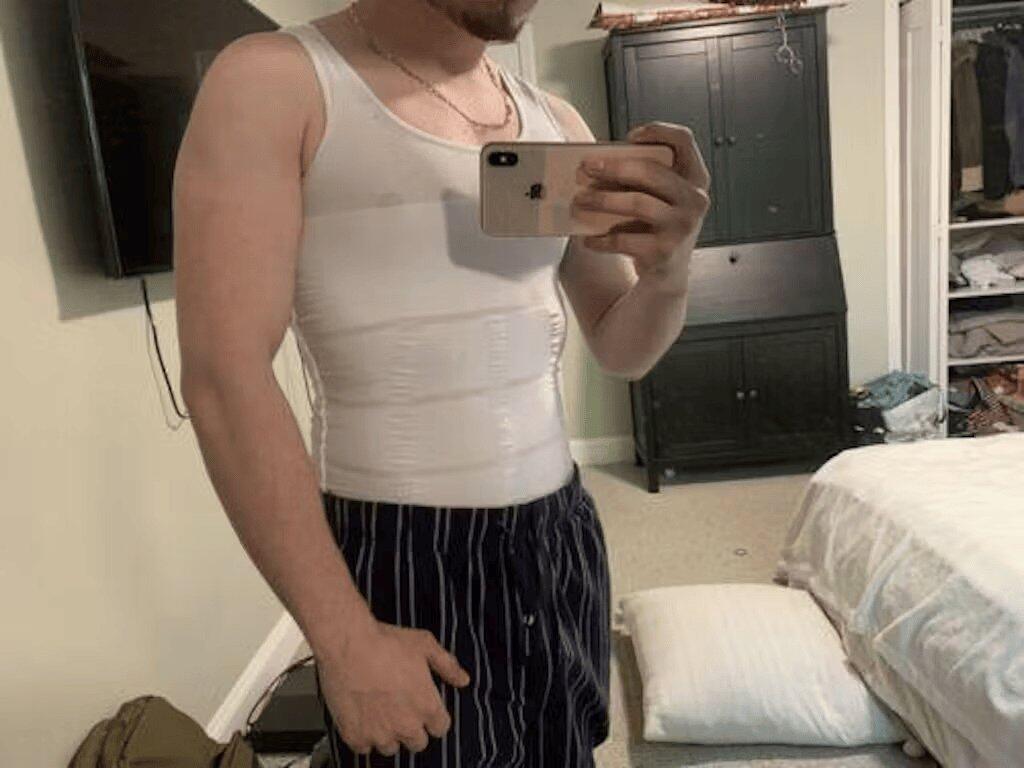
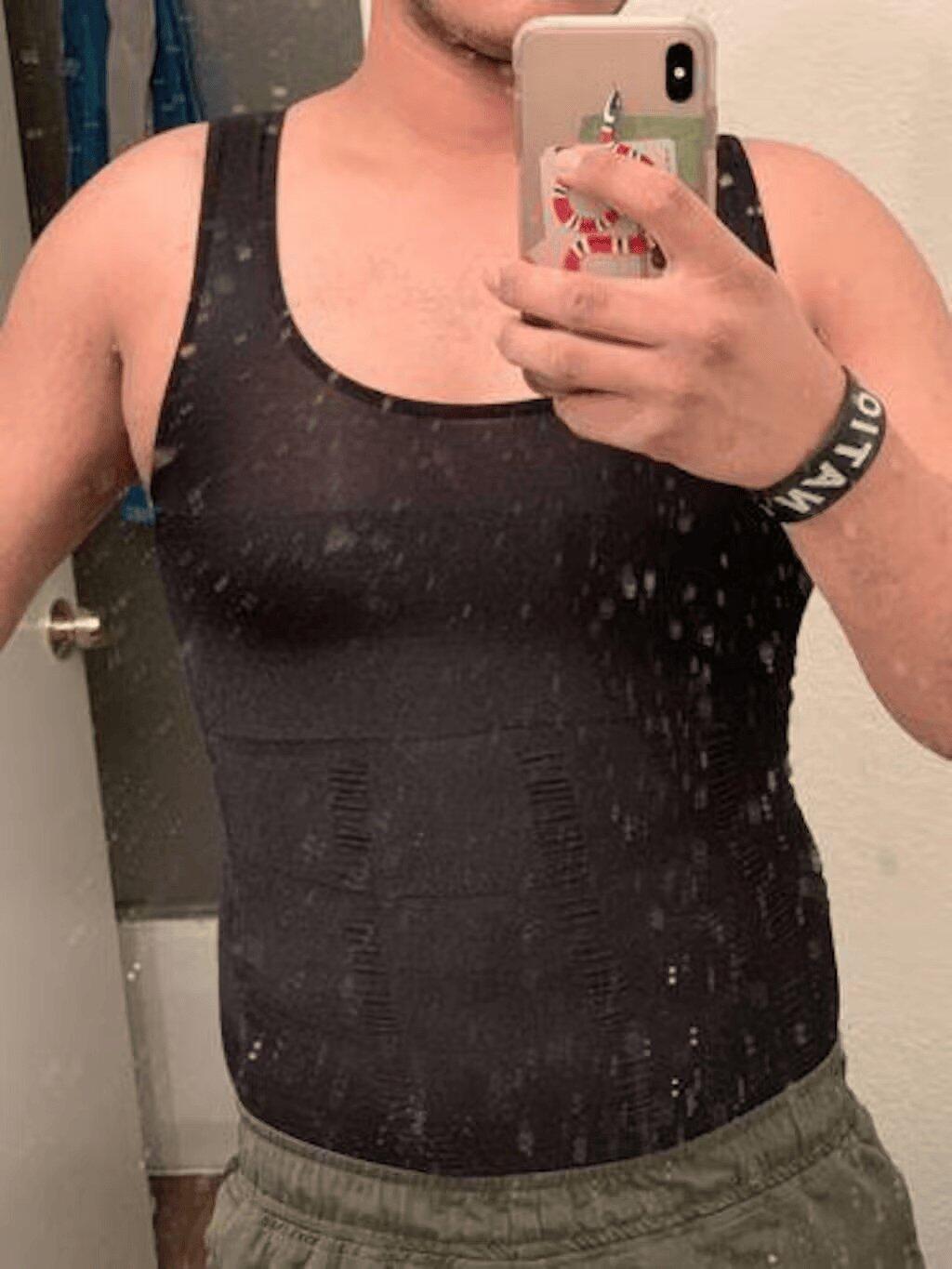
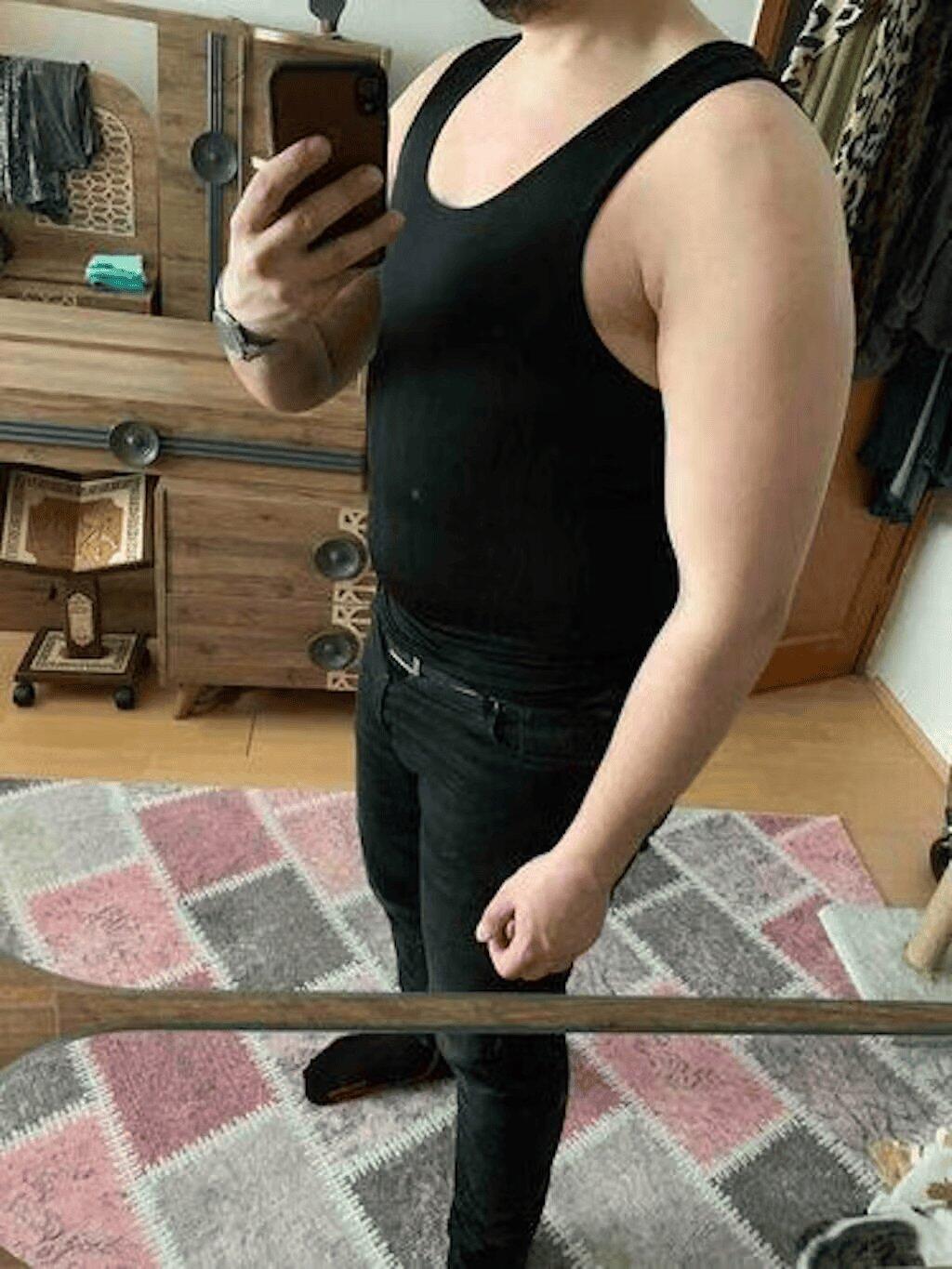
A separate base-layer question: if your outer shirt already fits correctly through the shoulders, chest, waist and length, but you want to compare a close first layer underneath, see the guide to a compression tank top for men. A base layer cannot repair wrong shoulder width, armhole geometry or garment length.

The Broad-Shoulder Fitting-Room Test
Do not decide from one relaxed front-facing pose. A shirt can look clean while your arms hang down and become obviously wrong the moment you move.
- Stand naturally. Check the intended shoulder line and whether the collar, chest and upper back lie calmly.
- Reach both arms forward. Notice pulling across the upper back, chest and armholes.
- Cross your arms. Check whether the back still has usable room.
- Raise your arms. Look for severe restriction or a shirt body that climbs excessively.
- Check the biceps and underarm. Enough shoulder width does not guarantee enough arm room.
- Now check the waist. Once the upper body works, see whether excess fabric is a taper problem rather than a size problem.
- Check body and sleeve length separately. Do not let one correct length persuade you to keep a tight upper body.
- Sit down. A clean standing fit should still let you breathe and move comfortably in the positions you actually use.
Fit the hardest area first. Diagnose the second failure before you change size again.
FAQ: Broad Shoulders and Men’s Clothing Fit
What is considered broad shoulders on a man?
Broad shoulders are best understood as a proportion: the shoulder line looks relatively wide compared with the rest of the frame. There is no single universal shoulder measurement that defines every broad-shouldered man because chest, waist, height and torso proportions change how that width reads.
How should men with broad shoulders dress?
Start by fitting the upper body without hard pulling through the shoulders, chest, upper back, biceps or armholes. Then diagnose what fails next — waist, body length, sleeve length or another area — and solve that problem with the right cut or alteration instead of automatically changing size again.
What shirts work best for men with broad shoulders?
The best starting shirt gives enough upper-body room without adding more torso width or length than you need. Athletic, tailored or tapered blocks can work well for some men with a narrower waist, but the measurements matter more than the fit label.
Should broad-shouldered men size up?
Size up when the current size cannot give the shoulders, chest or arms enough room. But once the upper body works, stop and check what changed elsewhere. If the larger size is now too wide or long, a different garment block may be better than moving up or down again.
Is athletic fit good for broad shoulders?
It can be a useful starting point because many athletic fits combine more upper-body room with a narrower torso. It is not a standard, though. Compare shoulder, chest, biceps, taper and length rather than trusting the label alone.
Are raglan sleeves good for broad shoulders?
They can work well for some men because the construction removes the conventional shoulder-edge seam and changes how the upper body is shaped. They are not automatically better. Chest, biceps, underarm room and torso fit still have to work.
What if my shoulders fit but my shirt is too big at the waist?
Treat that as a taper problem, not proof that the whole shirt is too large. Try a more tapered block, compare athletic or tailored cuts by measurement, or consider a torso alteration if the garment is otherwise worth keeping.
What should men with broad shoulders avoid wearing?
There is no universal avoid list because some men want to emphasize their shoulders and others want to balance them. The more useful rules are to avoid cuts that restrict upper-body movement and avoid repeatedly changing size when the real problem is a different pattern dimension.
Bottom Line
Broad shoulders do not require one special wardrobe. They require a better order of decisions.
Fit the garment’s intended shoulder construction. Test real movement. Then find the second failure instead of assuming the size is still wrong. If the waist, sleeve or body length fails after the shoulders work, solve that dimension directly. If the label says “athletic” but the block does not match you, ignore the label.
Only after the clothes fit should you decide what you want your shoulder line to do visually. Emphasize it, leave it neutral or balance it. All three are valid. The best result is the one that gives you usable movement, clean proportions and fewer compromises.
Technical references: Proper Cloth, “How the Shoulders / Yoke Should Fit” and “How to Select the Optimal Dress Shirt Shoulder Slope”; Rivet Patterns, “Raglan Sleeve: Wide/Square and Narrow/Sloped Shoulder Adjustments.” These references support garment-fit mechanics only; they do not prove one universal fit rule for every brand or garment.