Wide Hips in Men: How to Dress for Better Proportions
Before you decide your hips are the problem, look at the side pocket. If it kicks open, the upper trouser is under strain. If the pockets stay flat but the leg narrows hard below the thigh, the issue may be silhouette rather than size. For men with wide hips, those clothing clues are more useful than the body-shape label itself.
Quick answer: Men with wide hips should start with pants that have enough room through the hips, seat and upper thighs without obvious pocket flare or tension. Once the trouser top block fits, judge the leg shape separately: a straight or moderate taper can create a less abrupt hip-to-ankle change than a sharp taper, but no rise or cut is universally best. Then check whether your shirt catches or ends at the widest point, and use outer layers only when they improve the overall balance without adding bulk.
Wide Hips in Men: Start With the Clothes, Not the Label
There is no single clothing measurement that turns a man into a “wide hips” body type. In practice, the phrase usually means that the lower torso, seat or hip area reads wider than the waist or upper body, or that clothing makes that contrast more obvious.
That distinction matters because two men can describe the same problem and need completely different fixes. One pair of pants may be genuinely too tight through the seat. Another may fit the hips well but taper so sharply that the upper half looks wider by comparison. A shirt can create its own problem if it grips the hips or ends exactly where the body is widest.
So do not begin by asking, “What clothes hide wide hips?” Begin with a narrower question: what is the garment doing at the point where the silhouette starts to look wrong?
Clothing can change fit, drape and visual proportion. It does not change your underlying body structure. Keeping those two ideas separate makes the styling advice much more practical.
First, Find Where the Width Is Coming From
Look at the outfit in four zones before you change size. This prevents one correction from creating a new problem somewhere else.

| What you notice | Likely clothing issue | First thing to check |
|---|---|---|
| Side pockets bend open or diagonal lines pull across the hips | Not enough room through the trouser top block | Hip/seat and thigh room before changing the leg shape |
| The hips fit, but the lower leg gets very narrow | Strong hip-to-ankle contrast | Knee and leg-opening width |
| A shirt fits the chest but grabs at the hips | Body cut or hem position is fighting the lower torso | Shirt width, length and where the hem lands |
| Nothing is tight, but the outfit still looks bottom-heavy | Upper and lower halves carry very different visual weight | Outer-layer structure, shirt shape and overall contrast |
This is the main diagnostic move. If you can identify the zone that is failing, you can test one variable at a time instead of buying a larger version of the same cut.
Pants for Men With Wide Hips: Fit the Top Block First
For wide-hip fit problems, the waistband number is only part of the story. The upper section of the trousers also has to accommodate the seat, hips, upper thighs and rise. If one of those areas is short on room, the fabric has to borrow space from somewhere else.
Why Trouser Pockets Flare at the Hips
Stand naturally and look at the side pockets. They should lie close to the trouser seam rather than bowing open. Proper Cloth’s trouser-fit guidance identifies pocket flare and horizontal tension through the seat as signs that the hip area can be too tight; it also notes that waist tightness can contribute to the same symptom.

That is why simply going up one waist size is not always the cleanest solution. A larger size may remove the tension but leave too much fabric at the waistband or lower leg. First try a cut that gives more room where you need it. If the seat and thighs fit well and the waistband is only modestly loose, a tailor may be able to refine the waist without changing the entire silhouette.
Test Hip and Seat Fit With Movement
A front-facing mirror can hide problems that appear the moment you move. Sit down. Take a few steps. Put your hands in the pockets. If the waistband stays in place but the seat feels pinched, the pockets pull open or the upper thigh binds, the trouser shape is still asking the wrong area to absorb the strain.
Do not judge the ankle yet. A clean lower leg is irrelevant if the top of the trousers is fighting your body.
Straight vs Tapered Pants: Choose the Leg Line After the Hips Fit
Once the top block is calm, look at the line from thigh to shoe. This is where “athletic,” “straight,” “relaxed” and “tapered” labels can become misleading if you treat them as guaranteed answers.
For example, an athletic cut can be useful when your waist is smaller relative to your seat and thighs. Proper Cloth describes its athletic fit as roomier through the seat and thighs with taper toward the knee and leg opening. That solves one problem for some men and creates another visual question: how strong is that taper on your own frame?
If the lower leg narrows aggressively, the hips can appear broader simply because the silhouette changes width so quickly. A straighter or more moderate taper can keep the leg connected to the upper half without turning the trousers into a loose column.

Separate fit from silhouette. A trouser can fit correctly through the hips and still have a leg shape you dislike. Fixing the first problem does not force you to accept the second.
Should Men With Wide Hips Wear High-Rise or Pleated Pants?
“Wear high-rise trousers” is too simple to be useful for every man with wide hips. Rise changes where the waistband sits, how much of the torso is visible above it and how the front and back of the trousers have to travel around the body. For the broader fit decision, see how to choose high-waisted pants by rise and fit, including waistband position, top-block fit and movement testing.
Permanent Style’s guide to low-, mid- and high-rise trousers makes the key point: the label only becomes meaningful in relation to where the waistband actually sits on the wearer. A higher rise may give one man a cleaner continuous line. On another man, placing the waistband at a noticeably narrower part of the waist can make the waist-to-hip contrast more obvious.
The same caution applies to pleats. Pleats can provide useful room through the front of the trousers, but they are not automatically slimming and they cannot rescue a badly proportioned top block. Judge whether the front stays closed and calm when you stand, sit and walk. If you want the deeper construction comparison, use the separate guide to pleated vs flat-front pants.

The better question is not “Which rise or front style is best for wide hips?” It is “Which version gives me enough room without creating a new focal point?”
Shirts for Men With Wide Hips: Watch Where the Hem Ends
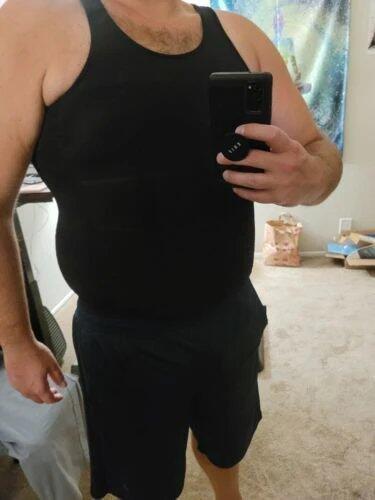
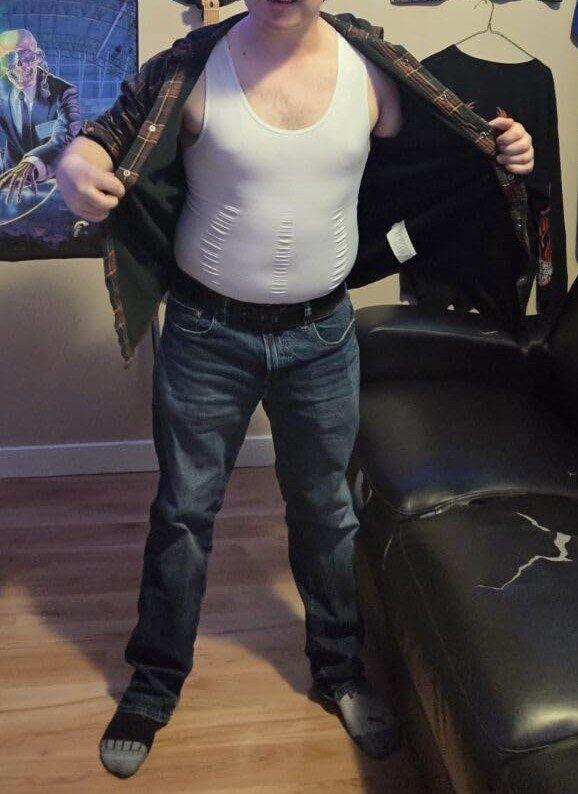
Trousers get most of the attention, but the shirt can exaggerate the same area in a different way. Two problems are especially common: the body of the shirt becomes tight as it reaches the hips, or the hem creates a strong horizontal line exactly where the lower torso is widest.
If a T-shirt fits your chest and shoulders but catches lower down, do not assume the next size up is the only option. Compare different body cuts. A slightly straighter or boxier torso can give the hem room to fall without turning the chest into a baggy rectangle.
Then check the endpoint. For an untucked top, test whether the hem falls cleanly past the widest point or ends before the fabric starts to cling. The exact answer depends on your height, garment length and outfit. The practical rule is to avoid a hem that stops at the widest point and grips it tightly.

If you tuck the shirt, the hem is no longer the visual break. The waistband is. That brings rise, belt contrast and trouser fit back into the picture.
Use the Upper Half to Balance the Outfit — Without Overcorrecting
You do not need to build an artificial V-shape with oversized shoulders. The clothing goal is simpler: give the upper half enough visual presence that the lower half does not become the only strong shape in the outfit.
An overshirt, casual jacket or sport coat can help when it adds a clean shoulder line and falls without ballooning at the hips. A very bulky layer can do the opposite by turning the entire torso into one wide block.

Color can help with continuity, but it is not a body-changing trick. Lower contrast between top and trousers can make the outfit read as one longer line; strong contrast at the waistband can make that division more obvious. Choose the effect you prefer rather than assuming dark trousers are a universal fix.
If the actual problem is that shirts or jackets never fit your shoulders correctly, that is a separate fit decision. The guide to dressing broad shoulders covers shoulder width, sleeve angle and upper-body fit in more depth.
60-Second Pants Fit Check for Men With Wide Hips
Use the same sequence every time you try on trousers and a top. It is faster than staring at one front-facing pose and trying to decide whether your hips “look wide.”
- Stand naturally. Check whether the pockets lie flat and whether the waistband twists, dips or digs.
- Turn to the side and back. Look for horizontal pulling across the seat or folds that suggest excess fabric.
- Sit down. The top block should still feel usable without the waistband being dragged out of position.
- Walk a few steps. Make sure the thigh and lower leg move without catching or staying bunched.
- Look from thigh to shoe. Only now judge whether the taper feels balanced or too abrupt.
- Add the shirt you will actually wear. Check whether it catches at the hips or creates a hard line at the widest point.
- Add the real outer layer. Make sure it adds structure rather than bulk.

If one garment fails in several places at once, try a different cut before paying to rebuild it. If the difficult areas already work and one smaller issue remains, alteration becomes a more sensible option.
When “Wide Hips” Is Actually a Different Clothing Problem
The phrase is broad enough that it can send you toward the wrong advice. Use the symptom that bothers you most to choose the next step.
| If your main issue is… | The more useful guide is… |
|---|---|
| Your whole frame looks broad or compact, not just the hips | How to Dress a Stocky Build |
| Soft tissue at the sides shows through shirts | How to Hide Love Handles Under a Shirt |
| Your shoulders are the part that makes shirts and jackets fail | Use the broad-shoulders fit guide linked above |
| The waistline makes your torso look long and your legs look short | How to Dress a Long Torso and Short Legs |
For wide hips specifically, keep the order simple: remove tension, judge the leg line, check the shirt endpoint, then balance the whole outfit. That gives you a repeatable way to improve proportion without pretending every man needs the same trousers, the same rise or the same silhouette.